Who Even Are You People? Part 3: Pete Binggeser
Pete Binggeser: terrier stalker, foosball statistician, keyboard whisperer.
Ian Belknap, , 5-minute read
As noted in Part 2, Pete Binggeser was still an architecture student when John Cain saw his mad scientist potential and had Pete come work with him at his company Iota Partners. In the first part of Distributed Cognition (see please Cuttlefish.) we described Pete as a tinkerer - a word than can imply something of the dotty amateur, futzing around in a garage (think of Belle’s dad in Beauty and the Beast,) but can also convey - and this is very much true in Pete’s case, somebody who’s resolved to crack the code of things, to both arrive at a deep understanding of how a thing functions, and, having decoded it, to devise ways to improve it.
And here’s where the question of deep understanding becomes a critical distinction, because “improvement” to Pete does not simply mean little tweaks that yield some tiny incremental gain, it’s a willingness to radically reimagine the thing itself and to remake it in ways that push it closer to the essence of its purpose, that make it more quintessentially itself. He’ll be the first to tell you that sometimes it’s incremental improvement that’s the only way currently possible to do this, so is an approach always worth considering and pursuing, but his is a mind willing to take great leaps, as well. As Cain notes about him, Pete has a rare capacity for holding the details of a thing in his mind, and the little ways of improvising those, while simultaneously reconceiving the thing altogether.
When Cain interviewed Pete for the gig with Iota (which readers will recall was a company wrestling with the many applications and questions at the dawn of Big Data, mostly by affixing various sensors and readers on products and in environments to harvest information for later analysis,) Pete brought in a visualization project he’d done that incorporated a bit of the “sensors in buildings” stuff he’d been doing in professor T.J. McLeish’s class at IIT, but in a way that reduced it to its essentials, portraying the capabilities of the technology at least as much as the behavior being analyzed.
The image Pete brought to John was a hectic-looking many-pointed asterisk type of deal, a picture that looked to have captured lots of ricocheting movement, which is exactly what it was: with a MacGuyver-ed combo of Arduinos (open-source single-board micro-controllers - this is the kind of word Pete routinely drops into conversation with the expectation that everybody would know what these are - I did not,) reflective tape for clear motion capture, and the repurposed remote for a Nintendo Wii, Pete created a visualization of his Boston Terrier playing fetch in Pete’s tiny apartment. In some mix of being impressed by this level of overkill-to-solve-what-was-never-a-problem, and the elegance of the improvised spliced-together components that yielded a clear and compelling visual representation of this under-studied phenomenon. Because WHEN will federal funders FINALLY devote adequate research dollars to the seminal question “But where exactly does the doggie go when playing fetch within a small space, though?”
After a couple years, Iota Partners got bought by Sapient, so the scrappy start-up team got folded into a much bigger organization. There was a foosball table in Sapient’s Chicago office which was a central fixture that provided frequent decompress-while-letting-your-less-conscious-brain-turn-some-problem-over-while-you’re-doing-something-else activity that, in a deadline-intensive, high-pressure environment, was a welcome aspect of office culture. Pete being Pete, he quickly concluded that “Hey - we should probably be ‘sampling the wares,’ here.” Meaning that the work for clients involved “instrumenting the world” in a bunch of cool ways, and “we’ve got hundreds of switches and microcontrollers and wiring lying around,” so why not build a custom thing to measure an existing component of our workplace conduct AND up the stakes of gameplay.
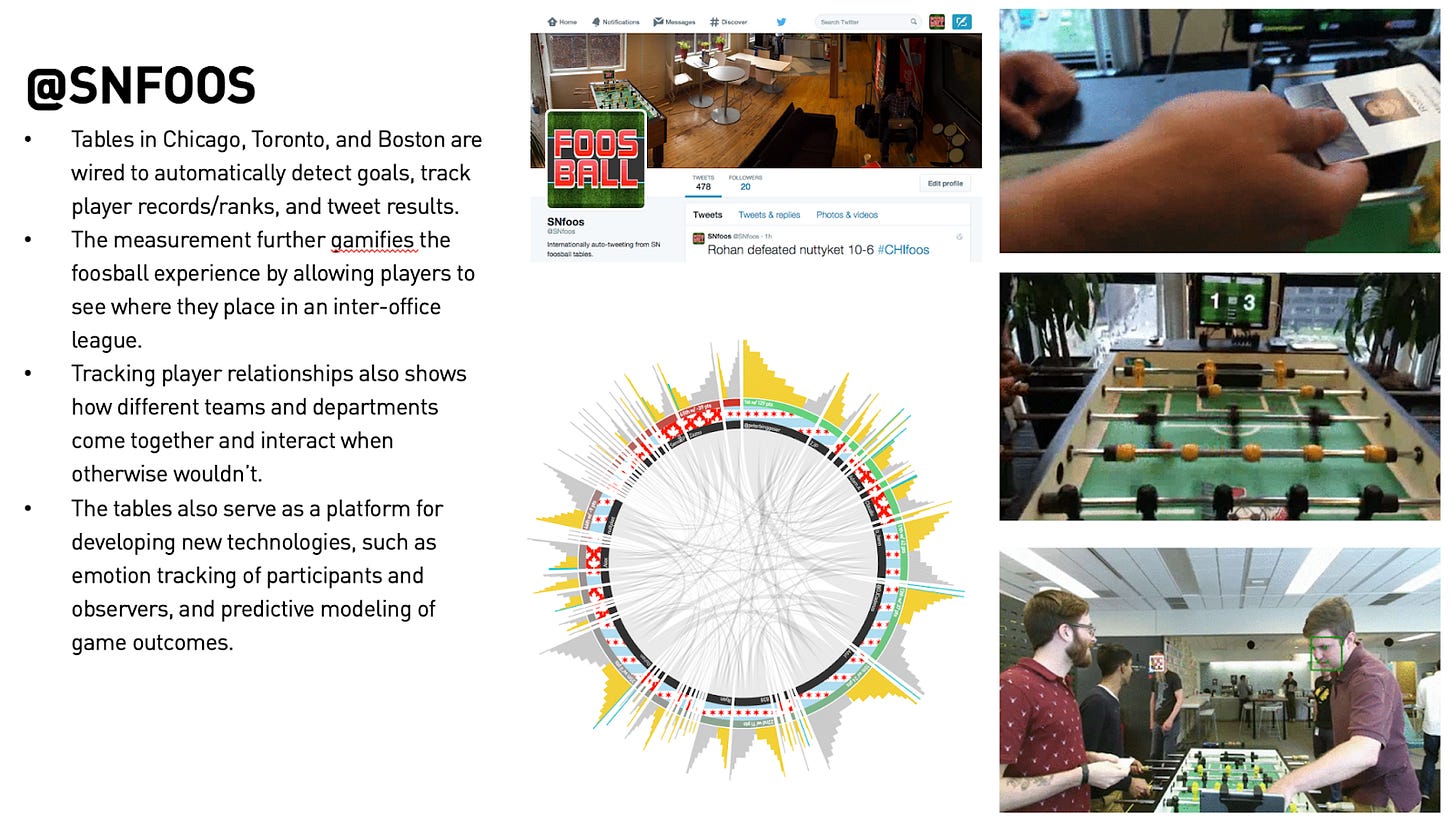
So he adds a couple goal-detecting switches and LEDs to automate score-keeping, then mounts a card-reader next to the table. Now every player can scan their company ID badge at the start of each game. He builds a database with everybody’s badge number to start, so you swipe your ID, enter the final score on a tablet, and an informal, ongoing tournament starts taking place. But then Pete’s like “Manually entering? What’re we, cavemen?” So he mounts a switch on each goal, boom, the score gets tallied automatically, winners and losers of each game updated in the database without a keystroke. As the body of foosball data grew, Pete finagled with his system some more, till gameplay got to the point where each player’s assigned a global ranking, like in the world of competitive chess, and the table itself is live-tracking, compiling, and updating the data to the point where the system could provide visualizations on the stats of any player.
This hobby project - which Pete started on more or less a lark, and which he added to and augmented on his own time - came to be a prominent stop on client office tours. This peculiar artifact demonstrated a great deal about the approach the company wished to portray: taking seriously problems that might seem minor, even trivial; bending and reshaping existing technology to uncover new uses for it; embedding the information capture required to analyze a problem into the environment where it takes place; synthesizing a wealth of information from multiple sources and presenting it in clear narrative ways. Over time, the foosball table came to be regarded as so emblematic of so many dimensions of the work that Pete got sent to other offices to install versions of it there, building a serious multi-site live-updating data set for a frivolous activity. In Toronto, though, where they are squares, they were a bit taken aback, like “You guys play foosball during work hours!?!” Yeah, Moose Knuckle. We do.
Here’s a snapshot of the foosball capture-and-analyze solutions Pete devised:
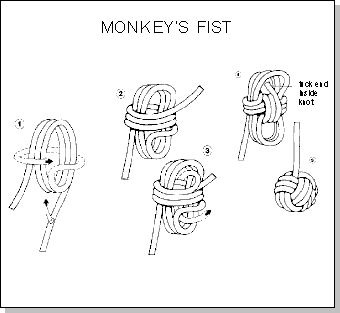
So, now that Pete is a grownup professional, co-founder of a cool company, guest lecturer at places like Berkley, etc., you might think he’s slowed his nerd roll a little bit. THINK AGAIN, Buster! When he’s not devising elegant work-related solutions in the material and virtual worlds, he's building his own synthesizers! That’s right. Mr. Man is deep into configuring and reconfiguring modular components of analog synthesizers. He calls forth music from NOTHING. And he can still tie a monkey’s fist, I bet.