Of Cuttlefish, Steam Power, and Killbots
Welcome to Distributed Cognition
Ian Belknap, , 6-minute read

The human brain - three or so glorious pounds of electrified jelly - is the centralized source of everything we call thought, from the tiny and localized (thrusting our hand out, feeling droplets, concluding that it is raining) to the vast and conceptual (things we cannot directly observe like the movement of galaxies.) This morphology - a single, central interpretive hub reading the signals traveling up and down the branches of a nervous system - makes intuitive, visceral sense to us. Our only apparatus for conceiving of anything is trapped inside one, after all.
It’s likewise sensible and “natural-feeling” to ascribe such a system to other creatures. When we gaze into the face of our dog (or, to lesser degree, our cat,) behind those warm eyes we infer a kindred and similarly mammalian means of forming thought - a globe of bone protecting an oblong of electrified jelly that sets her tail wagging. Your dog sucks at understanding particle physics, probably, but the cognition system inside her more or less resembles our own. It is easy to anthropomorphize her - to ascribe to her inner life attributes and capacities that resemble your own, and even though her little thoughts differ from our own, we can make sense of the pathways they travel.
This tendency comes less naturally when we look upon an octopus. Everything about the cephalopod is alien to us, the way they are put together and the ways they interact with the world defy our attempts to overlay the sensical map of our own consciousness upon them. It’s possible, certainly, to discern intelligence when looking into the weird, weird eyes of a squid or a nautilus or a cuttlefish, but it’s an opaque form of intelligence, one that does not make the same kind of intuitive sense to us as our dog’s. Study after study demonstrates that cephalopods are extraordinarily smart - able to solve novel problems with astonishing speed, freeing themselves from inside sealed jars, for instance - a famous recent example: Inky, the Common New Zealand octopus who escaped from his aquarium in 2016, busting out of his tank, crawling along the floor in the open air, and slopping down into a drainpipe into the harbor outside the building.
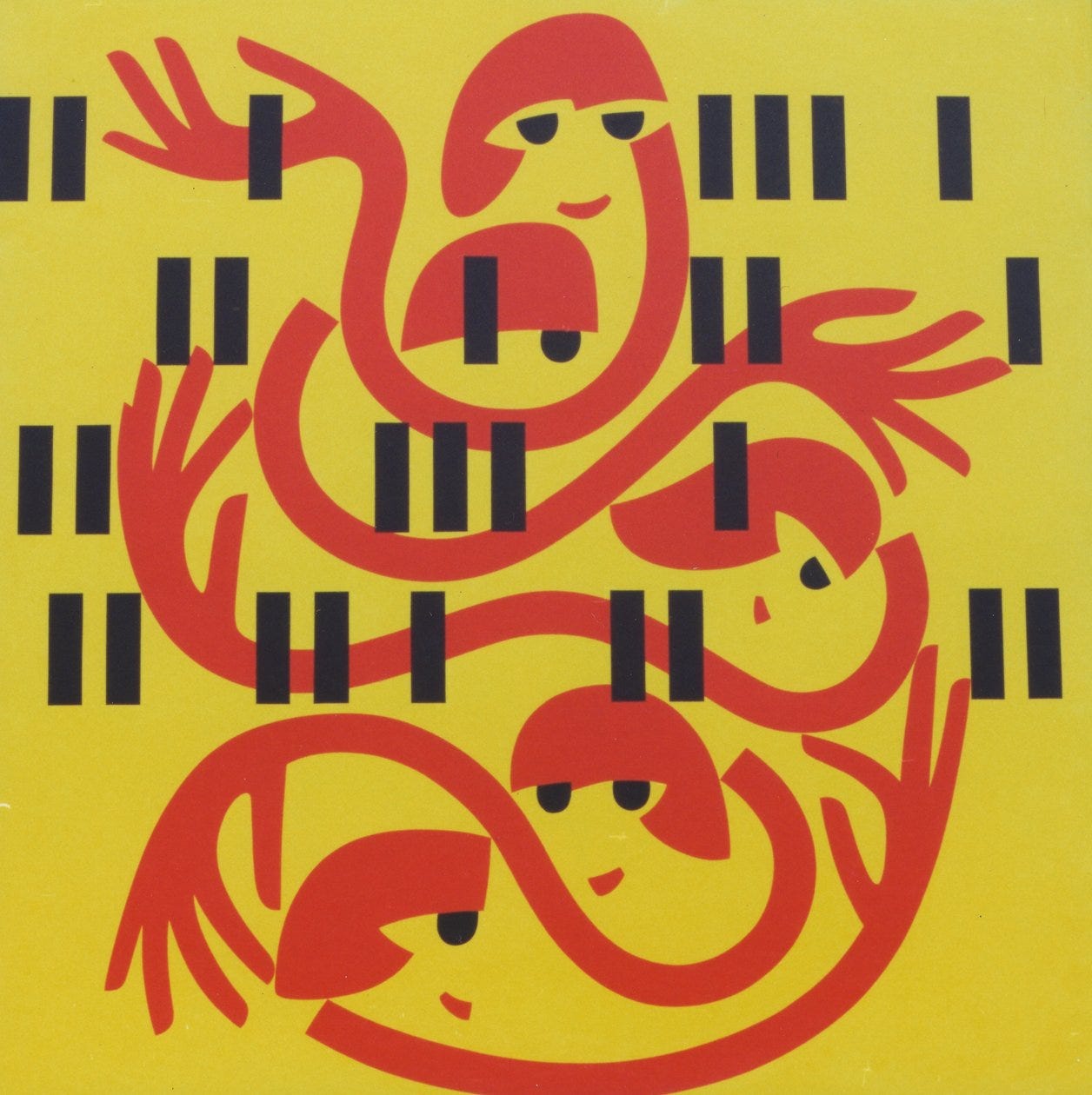
One of the deepest ways the cephalopod is foreign to us is that they’re multi-brained. The centrality of cognition that seems so natural to us does not pertain to an octopus or a squid - they have brains in each of their limbs, as well as the one in their head - each limb has autonomy, has volition, can make decisions independent of the animal’s other constituent parts - its brains may coordinate and collaborate, or each may function independently. Which is a profoundly weird thing to try to imagine - it’d be like if you had a brain in each hand and foot that could choose whether or not to listen to the brain in your head, like your head brain might tell your hand brain: “Grab that outcropping - let’s finish climbing this rock wall,” and your hand brain might be like “No can do - I’m dealing blackjack,” and your foot brain might be like “Do you MIND? I’m TRYING to read down here,” or whatever. But then, when all your brains feel your body starting to fall, and everybody puts their own projects aside and pitches in and you climb the rock wall.
A Large Language Model (LLM), when utilized well and fully, is like a many-brained cephalopod—a collective of intelligences capable of independent decision-making, alternating their focus between individual side quests and shared objectives. Just as each arm of an octopus can explore and interact with its environment independently yet still serve the needs of the whole organism, an LLM processes information in ways that are BOTH distributed AND cohesive.
Alarmists and catastrophizers believe we are at the dawn of Skynet. They argue that the explosion of AI capabilities will inevitably lead to an adversary smarter and swifter than we are, one which will conclude that humanity is its only real competition and seek to destroy us. However, they fail to grasp the nature of the brain in question—it's an arm-brain; it does arm stuff. In other words, AI operates within a specialized scope, executing the tasks it's designed for (tasks, in other words, that we assign to it) rather than devising grand schemes against humanity.
An LLM processes information in distributed yet cohesive ways, utilizing its neural network architecture to generate responses based on learned patterns. However, it's essential to recognize that while the model can produce a wide range of outputs, it operates within the boundaries of its training data and does not possess an infinite repository of knowledge or infinite capacity for creativity.
The fallacy of centrality, the mistaken if organic-seeming belief that a centralized system is inherently superior for organizing and processing information or tasks, has a couple of readily foreseeable pitfalls as a consequence of cleaving to it too closely. Since this “natural” inclination readily congeals into a preference, then crystalizes into a*[n imagined]* requirement, we impose a similar “body plan” onto larger systems - a central brain does the thinking/reasoning/planning, subordinate components carry out the tasks. As the Industrial Age displaced the agrarian model humans had lived under for millennia, there was a practical advantage to centralizing - bring the labor to the machines in order to do the work; a textile mill is a gathering of looms that need people to run them, so it made sense to have those looms in a fixed location and bring the human operators to them, not vice versa. 20th century corporations were bound by similar consolidating impulses: when the flow of information must be input by hand onto physical paper, it made sense to have a typing pool in a single office space, or when the thousands of pieces that combine to make an automobile need assembling, it was logistically sensible for the hundreds of people required to do so on a factory floor under one roof.
This centralized manner of doing things contrasts sharply with much of today’s work - the multiple forms of cognition required to build a mobile app, say, or an operating system, an interface or a videogame, are not bound by the same rules of geographical centrality. Even work that produces a physical artifact - a smartphone, for example - has many layers of thought and decision making that are not involved in the form and materials of the ultimate product. We have already begun our transition into distributed cognition - if a team in Taipei is writing code for a tablet that’s to be assembled in Shenzhen, say, or the semiconductors made in a plant in Dresden that are to power components designed in Rotterdam for an electric bike to be built in Glasgow - there is already precedent for the multi-brained cephalopod approach to solving complex problems. It’s quite common, now, for each of us to enjoy the fruits of this kind of far flung thought, and likely as not we’re daily participants in some form of it in our own work - a graphic designer tweaks the arrangement of text written by someone else far away, a developer writes code to prototype a concept devised by a team in a different division of a company, etc. We collaborate, co-thinking about the solutions to problems, asynchronously and across distances all the time.
BIG HONKIN’ ASTERISK (the only punctuation so aptly many-limbed) - we are NOT suggesting that the rise of AI means there will be autonomous brains everywhere. The LLM is NOT its own brain. The LLM permits ready ACCESS to bodies of knowledge, it does not GENERATE novel thought.
The effective embrace of distributed cognition allows us to harness the collective intelligence of diverse minds, tools, and approaches, paving the way for innovative solutions to complex problems. AI tools like LLMs facilitate this distributed cognition by providing access to information of every description and aiding collaboration, but they are tools that augment human thought, they do not and cannot replace it.
As a company, ZeroWidth endeavors to both sharpen the tools in the LLM shed, and to smarten our own thinking about how these tools can help us. These intertwined, interdependent threads of thought will animate and inform the ongoing inquiry of this newsletter. We believe that the way forward must be propelled by a clear-eyed optimism - optimism for the soon-to-be astonishing ways LLMs can help us, clear-eyed about the capabilities and parameters of the technology, and about the skill and intent of the humans deploying it. By embracing this collaborative approach, ZeroWidth seeks to remain at the forefront of innovation, ready to tackle the complex challenges of today and tomorrow.